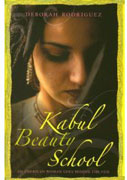
In one of the more memorable scenes in Kabul Beauty School: An American Woman Goes Behind the Veil, author Deborah Rodriguez teaches a group of Afghan beauty students the rules for dying hair. Struggling to convey the principles of the color wheel across linguistic and cultural differences, Rodriguez nearly gives up: “After three days of class, they just look at me like I’m speaking Greek,” she complains to a friend. “I don’t think I’m going to be able to teach them anything.” The friend urges patience, and a chastened Rodriguez, alive to the difficulties of her students’ chaotic lives, tries again. “The next day, I had a breakthrough,” she writes. “I was trying one more time to get across the idea of the contributing pigment as something you had to counteract in order to get the color right. They were all looking at me with courteous incomprehension — blank if benign stares — and I was groping around for an analogy. ‘Think of it as Satan!’ I finally said, pointing at a patch of orange paint.…