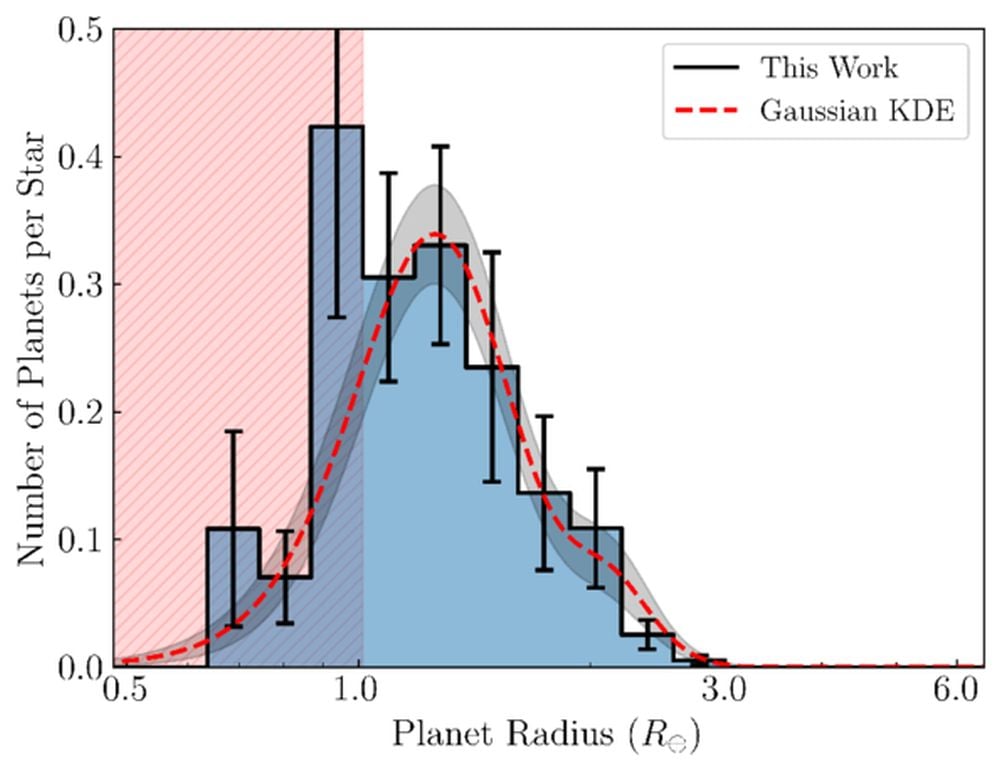
The NASA planet-hunting satellites Kepler and TESS scanned the skies autonomously, searching for the tiny dips in light caused by exoplanets transiting in front of their stars. Their diligent observations uncovered more than 6,000 confirmed exoplanets. As scientists examined the types of planets the spacecraft found, they discovered some patterns that need explanations. One of those patterns is the radius valley, also known as the Fulton Gap, the small planet radius gap, or the photoevaporation gap. It's a lack of exoplanets within a certain size range. Astronomers have found very few exoplanets between about 1.5 and 2 Earth radii. The valley exists within the population of small planets that are close to their stars and have orbital periods shorter than 100 days. The valley is bookended by rocky super-Earths and mini-Neptunes. There are very few exoplanets in between them. Scientists think that photoevaporation of atmospheres can create the valley, or core-powered mass loss .…