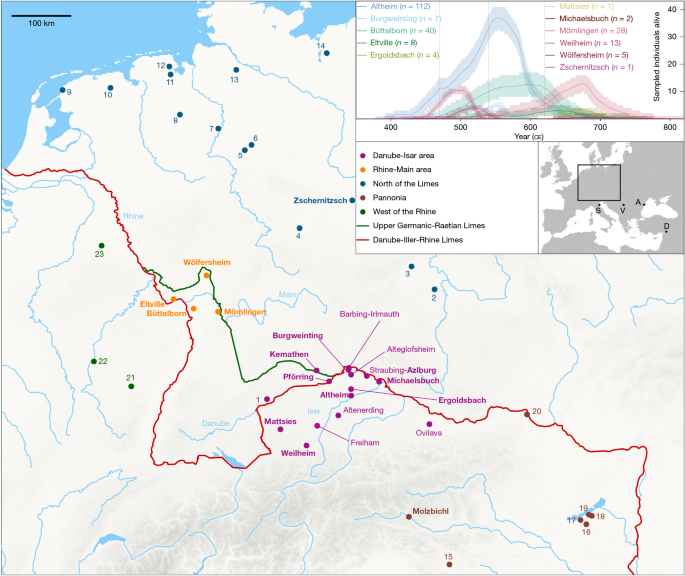
Main During the transition from Late Antiquity to the Early Middle Ages (fourth to seventh century ce ), Central Europe experienced profound political, cultural and demographic changes, marked by the dissolution of Roman rule, the spread of Christianity, and new settlement patterns. The political landscape shifted dramatically, with the emergence of new polities in Western and Central Europe. Yet knowledge of local societies and the lives of non-elite people remains limited, as written sources are scarce and few settlements have been fully excavated 4 . Cemeteries linked to rural settlements therefore provide key information on this transition. From about 450 ce onwards, distinctive furnished ‘Row-Graves’ appeared across the former Roman frontier regions, from Northern France and the Netherlands to Northern Italy and Western Hungary 5 . These burials, often furnished with clothing, weapons, jewellery or vessels, offer unique insights into everyday life and death in fifth to seventh century Europe 6 .…