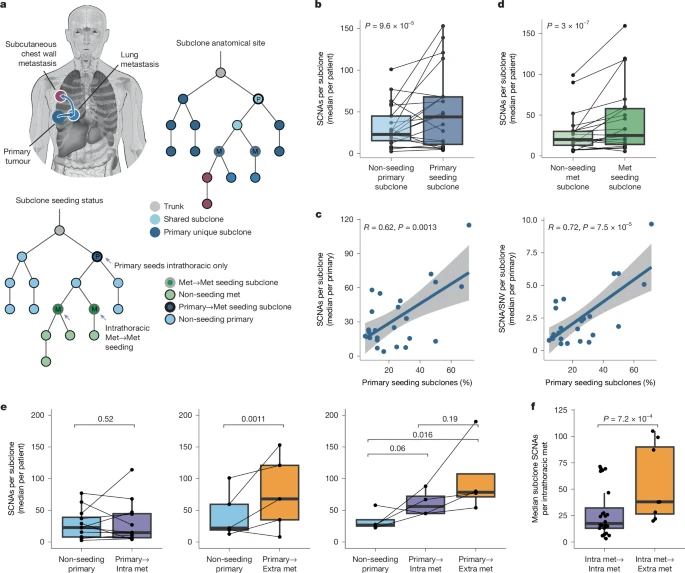
Main Metastasis, the process by which cancer cells spread from their site of origin to a secondary location, is the leading cause of cancer-related mortality 2 . Lung cancer accounts for the largest share of metastatic cancer cases 3 , owing to its high incidence 4 , frequent presentation as de novo metastatic disease 5 and high rate of relapse after curative-intent surgery for localized disease 6 . Understanding the genetic basis for the mechanisms that enable cancer cells to migrate from the primary site into local tissues, air spaces, lymphatics and/or circulation, and to ‘seed’ foreign ‘soils’ 7 , could inform strategies to prevent and treat this lethal condition 1 . The migration of cancer cells is a transient event that is difficult to observe in patients in real time; however, a retrospective view of this process can be gleaned by tracking the evolutionary history of subpopulations of cancer cells, or subclones, in primary tumours and metastases using DNA-sequencing data 8 , 9 , 10 , 11 , 12 .…