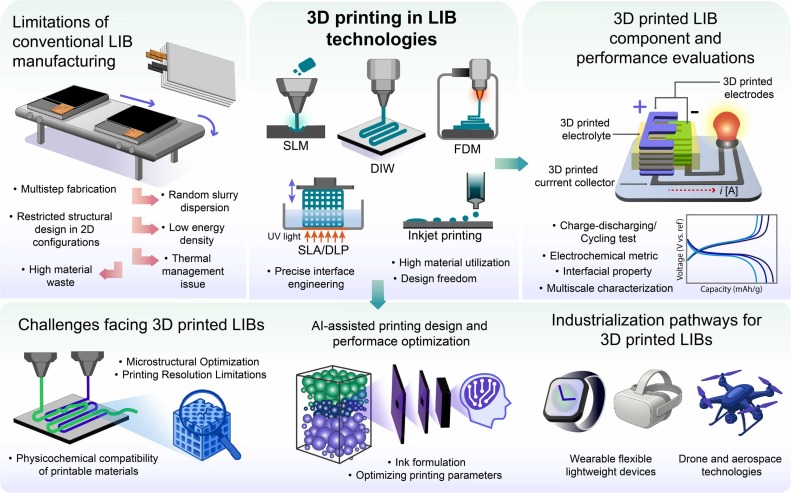
A study published in Materials Science & Engineering R argues that 3D printing is ready to move from laboratory prototyping to mainstream lithium battery manufacturing, provided several unresolved material and process problems are brought under control. The central argument is that print-defined architecture, not just chemistry, is becoming a meaningful variable in battery performance. To make that case, the paper surveys experimental results across four printing techniques: direct ink writing, laser powder bed fusion, photopolymerization-based methods including stereolithography and digital light processing, and fused deposition modeling. (A) Schematic illustration of the manufacturing process of lithium-ion batteries. (B) 3D printing techniques applied to lithium battery components. Image via Jing Wei et al., Materials Science and Engineering: R: Reports. Engineering Performance Gains and Technical Limits The performance comparisons it assembles are specific.…