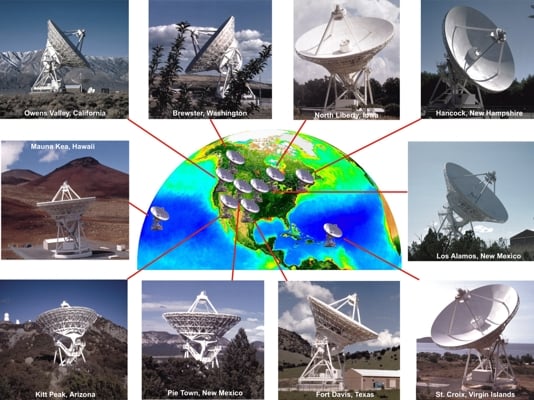
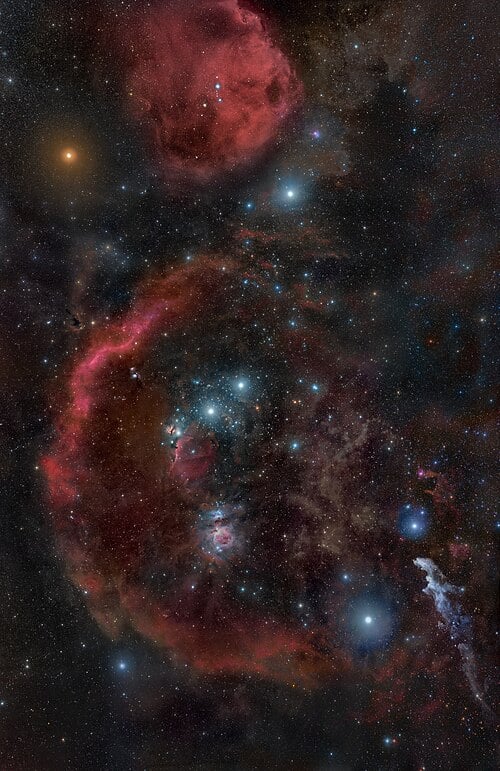
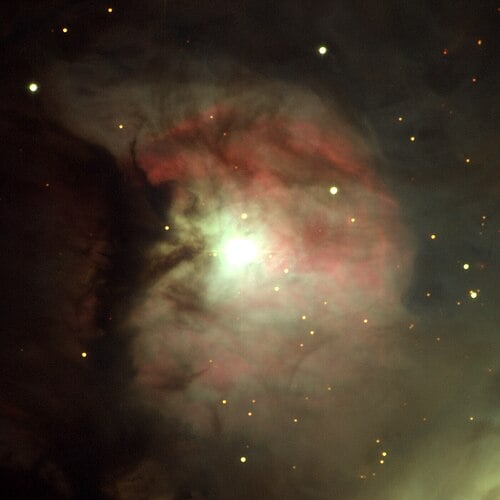
The Orion Nebula provides a master class in the study of stellar formation. Yet, many of its youngest stellar objects are still swaddled in their birth crèches, hidden by clouds of gas and dust. The Very Large Baseline Array (VLBA) radio telescopes have managed to punch through the dusty obscuring veil to study a pair of young binary systems called Brun 656 and HD 294300 born in the Nebula. The result of the observations is a very accurate calculation of the masses of the stars in those systems. Lead researcher on the observations, Dr. Sergio Abraham Dzib Quijano, from the Max Planck Institute for Radio Astronomy pointed out how important this measurement is. “Stellar mass is the most fundamental property of a star," he said, "yet it is notoriously difficult to measure for young, embedded systems.” VLBA solved the difficulty by observing at radio wavelengths of 5 GHz using the full array of telesscopes. That 5 GHz is a region where dust is transparent, and radio wavelengths can get through.…