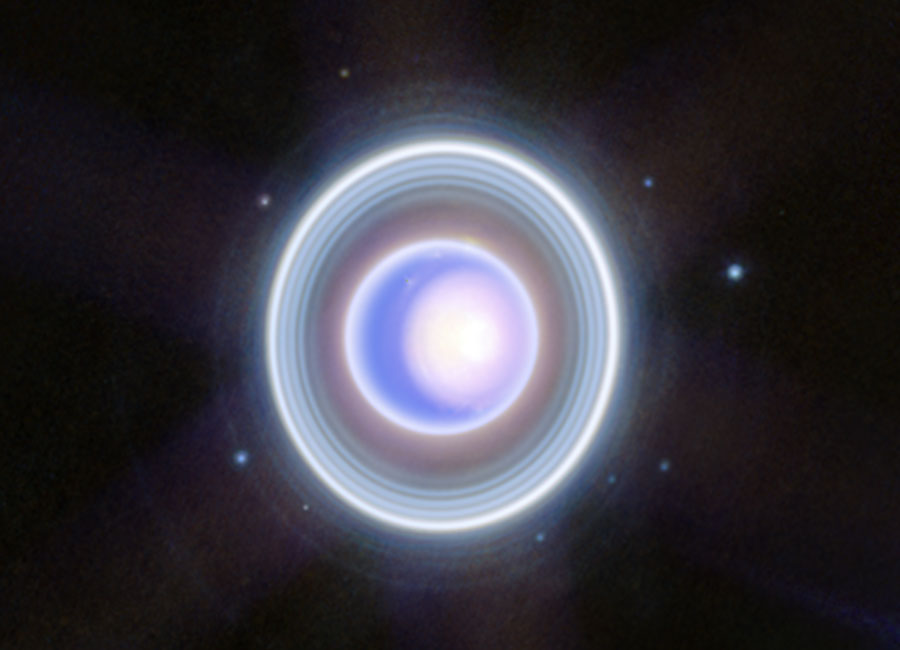
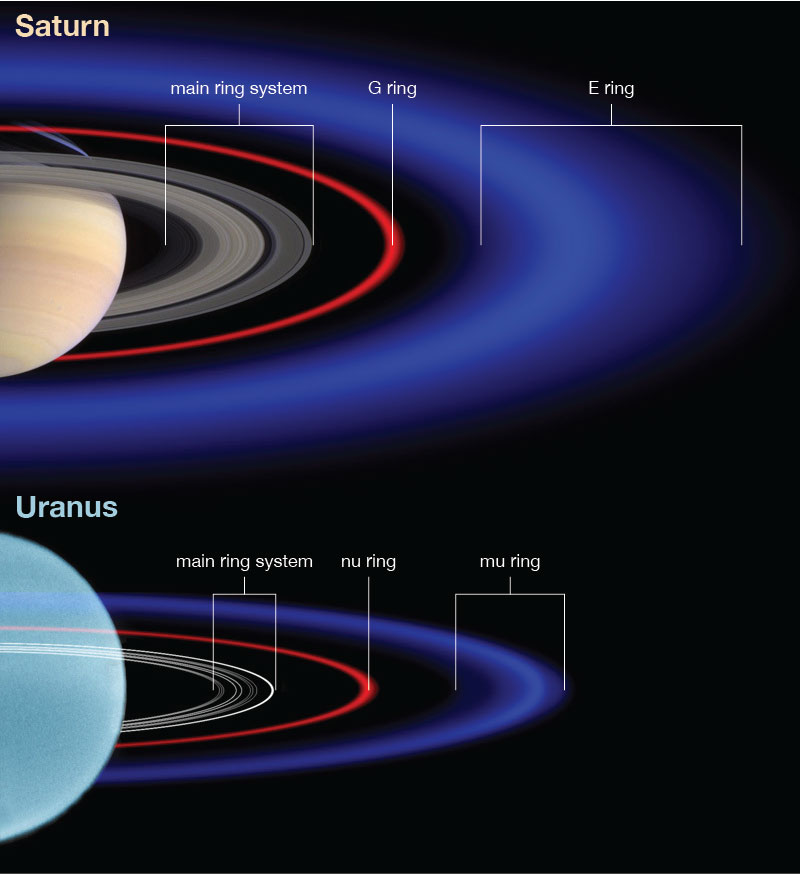
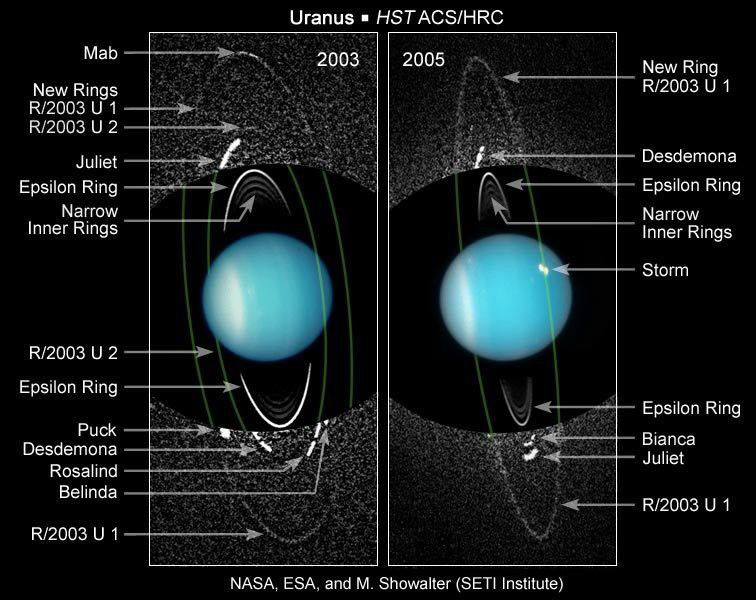
The James Webb Space Telescope has taken a deep look at the rings around the ice giant Uranus and found a new mystery to be solved. JWST image showing the whole ring system. The nu and mu rings are just barely visible. NASA / ESA / CSA / STScI James Webb Space Telescope’s sharp color vision has found water and carbon compounds in Uranus’s outer rings — but not in the same place. Astronomers have known that the two rings were different colors since their discovery. But the finding of ice in one ring and dust in the other creates a new mystery: What’s going on with the tiny ice-moon Mab? Saturn-like Rings Uranus’s ring system is less familiar to us than Saturn’s, but the two are similar. Just like Saturn’s, Uranus’ main ring system is about twice the planet’s width. Within this distance, moons can’t coalesce, because tidal forces exerted by the planet’s gravity would tear them apart. Instead, orbiting particles of dust, ice, and rock spread out into planet-encircling rings.…