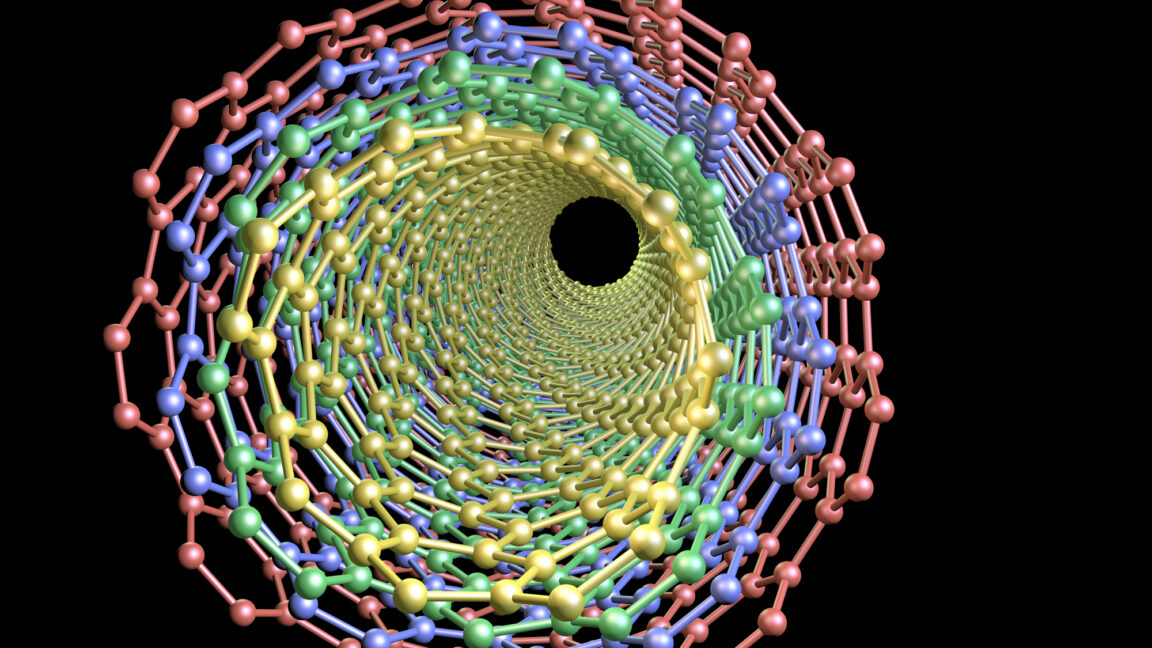
Skip to content While this material degrades over time, it could point to better ones. A multi-walled carbon nanotube. In this work, the tubes only had two layers. Credit: theasis A multi-walled carbon nanotube. In this work, the tubes only had two layers. Credit: theasis Shortly after their discovery, carbon nanotubes seemed to be a material wonder. There were metallic and semiconducting forms; they were tiny and incredibly light; and they could only be broken by tearing apart chemical bonds. The ideas for using them seemed endless. But then the reality of working with them set in. It was hard to get a pure population of metallic or semiconducting forms. Synthesis techniques tended to produce a tangle of mostly short nanotubes; those that extended for more than a couple of centimeters remain rare. And while the metallic version offered little resistance to carrying electric current, it was hard to send many electrons down the nanotube.…