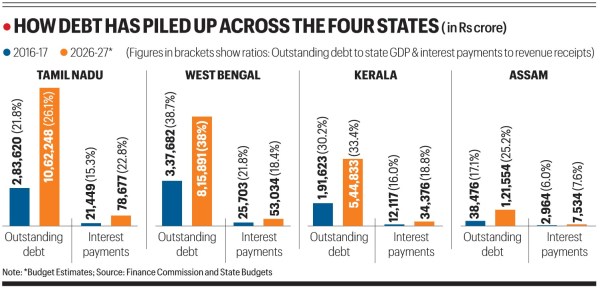
The newly elected governments of all four states that went to the polls — Tamil Nadu, West Bengal, Kerala and Assam — will have one major challenge to confront: The burden of debt. Tamil Nadu ’s outstanding debt — the total money the state government owes to lenders at a given point — has nearly quadrupled from Rs 2.8 lakh crore to Rs 10.6 lakh crore between 2016-17 and 2026-27 (April-March). The stock of debt has also risen from 21.8% of the state’s gross domestic product (GDP) to 26.1% over this period. This debt pile-up has been accompanied by ballooning interest payments, from Rs 21,449 crore in 2016-17 to a budgeted Rs 78,677 crore for 2026-27. That’s not all. Ten years ago, interest payments consumed 15.3% of the Tamil Nadu government’s total revenues (or income from both tax and non-tax sources). This financial year, that ratio is expected at 22.8%. An unsustainable proposition The story isn’t much different for West Bengal and Kerala.…