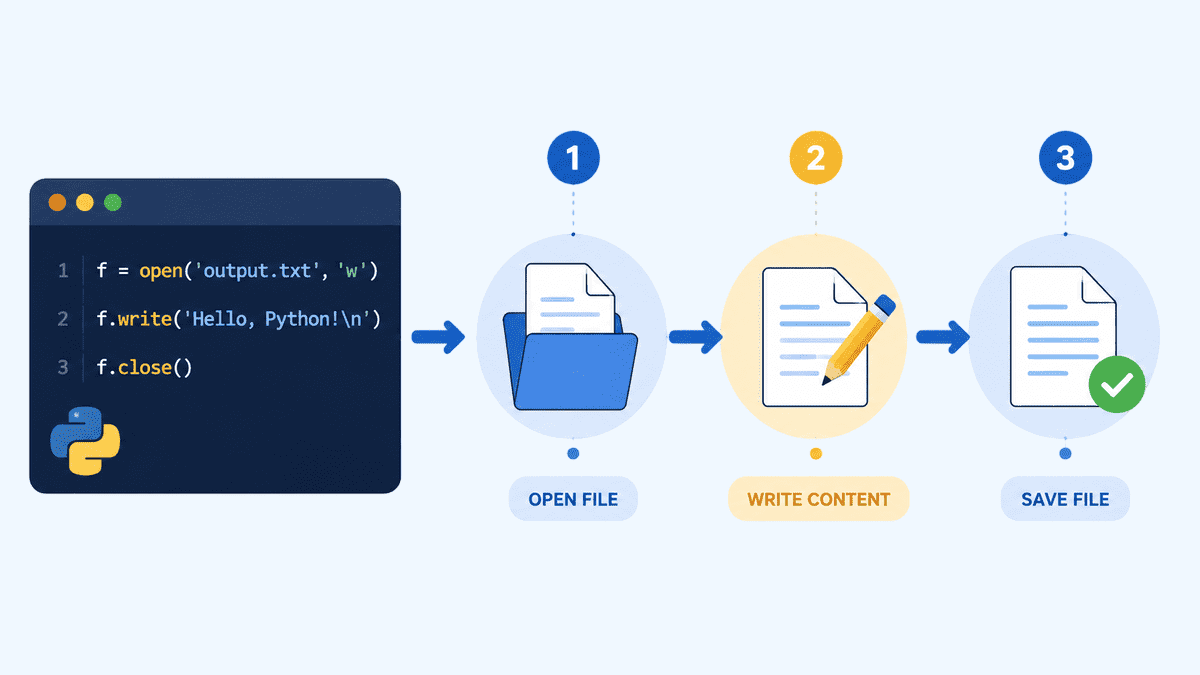
# Introduction Writing to files is an essential Python skill. It lets you save data permanently instead of losing it when your program stops. You can use file saving to store results, logs, reports, user input, settings, and structured data. In this guide, you will learn how to create text files, write multiple lines, append content, work with folders, and save data in CSV and JSON formats. You will also learn the most common file modes, including w , a , x , and r , and when to use each one. By the end, you will be able to write Python programs that save results, reports, logs, and structured data to files. # Writing Your First Text File The simplest way to write to a file is to use Python's built-in open() function. The w mode means write mode. If the file does not exist, Python creates it. If the file already exists, Python replaces its existing content.…