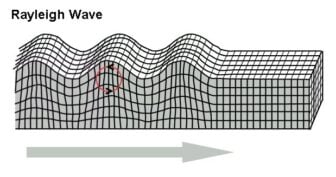
On the smallest scales, ordinary materials behave in ways that seem to defy the laws of physics. But these apparent contradictions reflect the minute details we’ve yet to discover in nature—as demonstrated by a new finding showing how solids can support wave-like shapes we typically see trailing behind boats on water. In a recent Physical Review Letters study, Harvard researchers describe how it’s possible to engineer steady V-shaped wakes that ripple across the surfaces of ultrasoft, elastic materials like gels or biological tissue. Based on lab experiments, the team developed a theoretical model to explain this behavior, bridging two classical theories of fluid and solid surface-wave physics. This renewed perspective on solid physics opens new pathways for designing natural and engineered soft materials, particularly for medical purposes.…