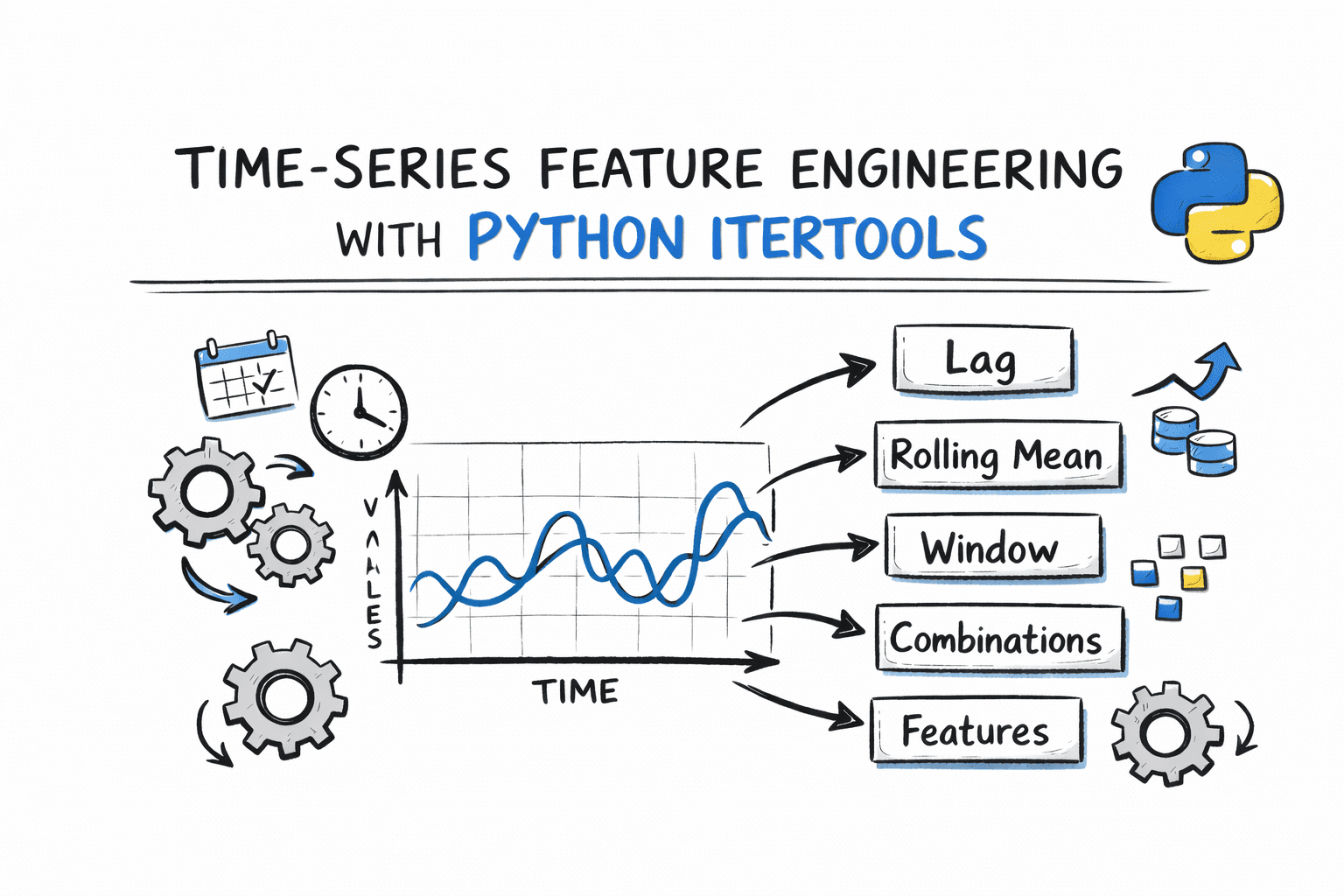
# Introduction Time series feature engineering doesn't follow the same rules as tabular data. Observations aren't independent, row order isn't incidental, and the most useful features are rarely individual readings. You'll have to identify patterns across time like rates of change, lag comparisons, deviations from a rolling baseline, and more. Building lags, sliding windows, and grouping across resolutions are all, at their core, iteration problems over ordered sequences. Python's itertools module is a natural fit for this kind of work. It doesn't replace high-level pandas abstractions like .rolling() , but it gives you lower-level building blocks to construct exactly the features you need, with full control over the logic. In this article, you'll build seven categories of time series features using itertools. You'll also apply each to a sample dataset. You can get the code on GitHub .…