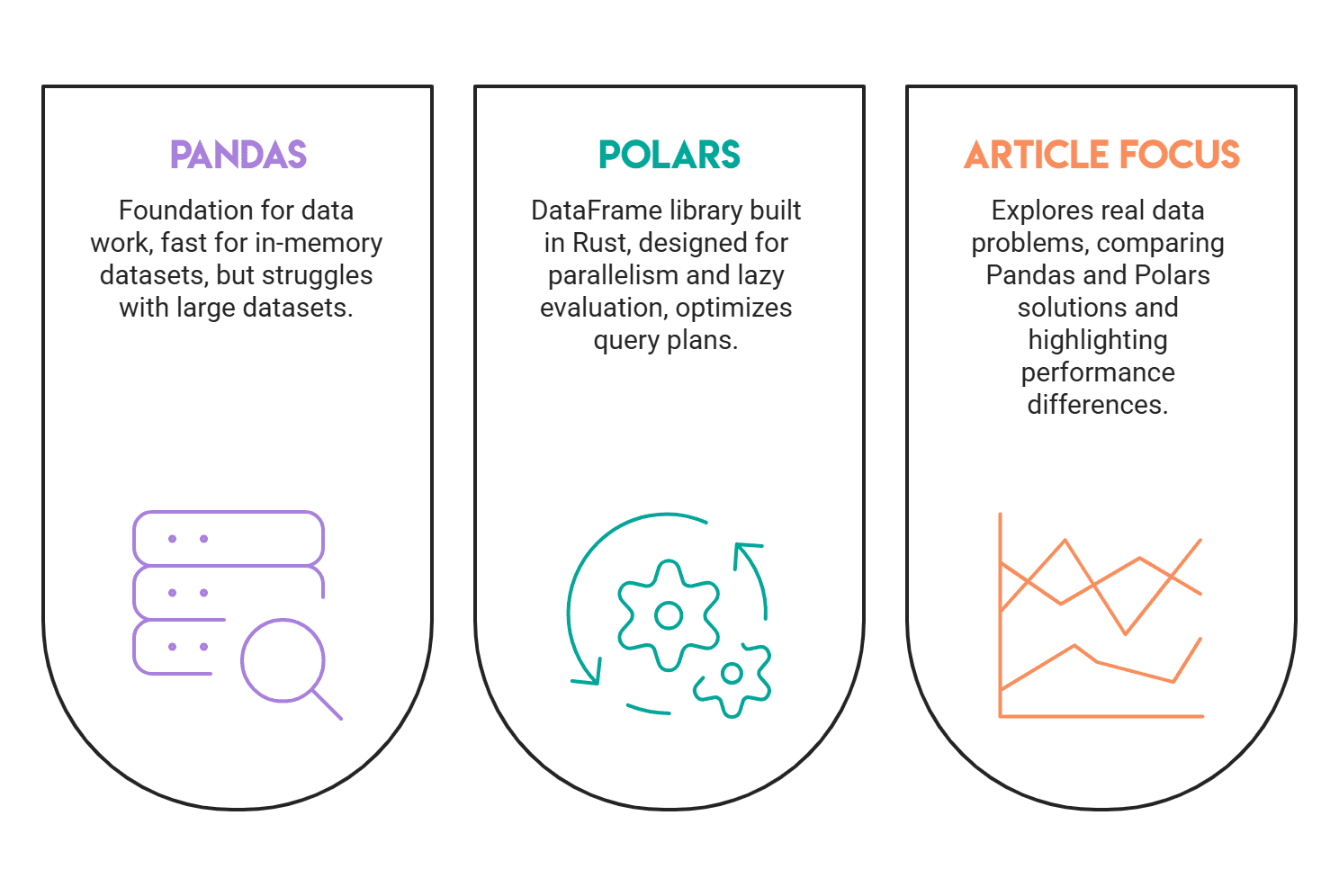
# Introduction Over the last decade, Pandas has been the foundation for data work in Python. For datasets that fit in memory, it is fast and familiar enough that switching libraries rarely crosses any programmer's mind. However, once you start working with millions of rows, the flaws start to appear: groupby operations that take several seconds, intermediate copies that consume RAM, and window functions that run as Python-level loops rather than vectorized C or Rust code. Polars is a DataFrame library built in Rust on top of Apache Arrow . It was designed with parallelism and lazy evaluation as first-class features. Pandas executes each operation upfront and in sequence, whereas Polars can build up a query plan and optimize it prior to executing, with most operations executing concurrently across all available CPU cores automatically. In this article, we explore three real data problems using real questions from the StrataScratch coding platform.…