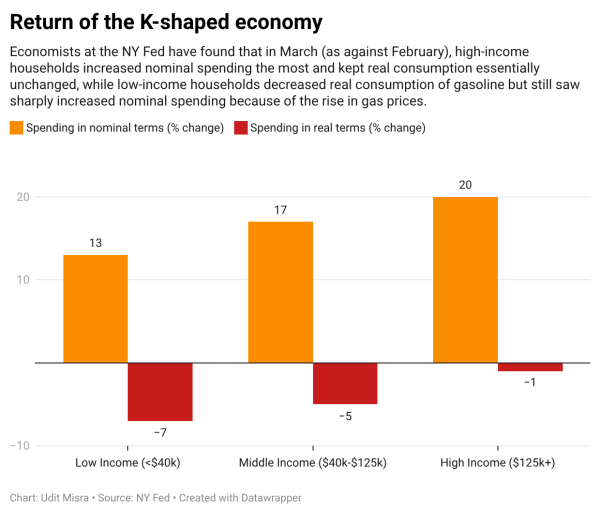
A US gasoline pump. Gasoline prices have spiked in the US amid the Iran war. AP As the conflict in West Asia continues to strangle fuel and fertiliser supplies across the world, pushing up prices and the cost of living, a familiar question has resurfaced: Who gets hurt the most? Whether one talks about individuals or families or whole economies, the short answer is that there is a stark difference between how such a crisis affects the haves and the have-nots. In other words, often such crises create a K-shaped economy. This is a phenomenon where the economic divisions and inequalities widen with one (often small) segment of the economy tending to consume heavily while another (often large) segment struggles to even consume the staples. A K-shaped economy The war in Iran is already beginning to reveal a K-shaped pattern. Economists at the Federal Reserve Bank of New York recently analysed the way US consumers spent on fuel as pump prices started increasing.…