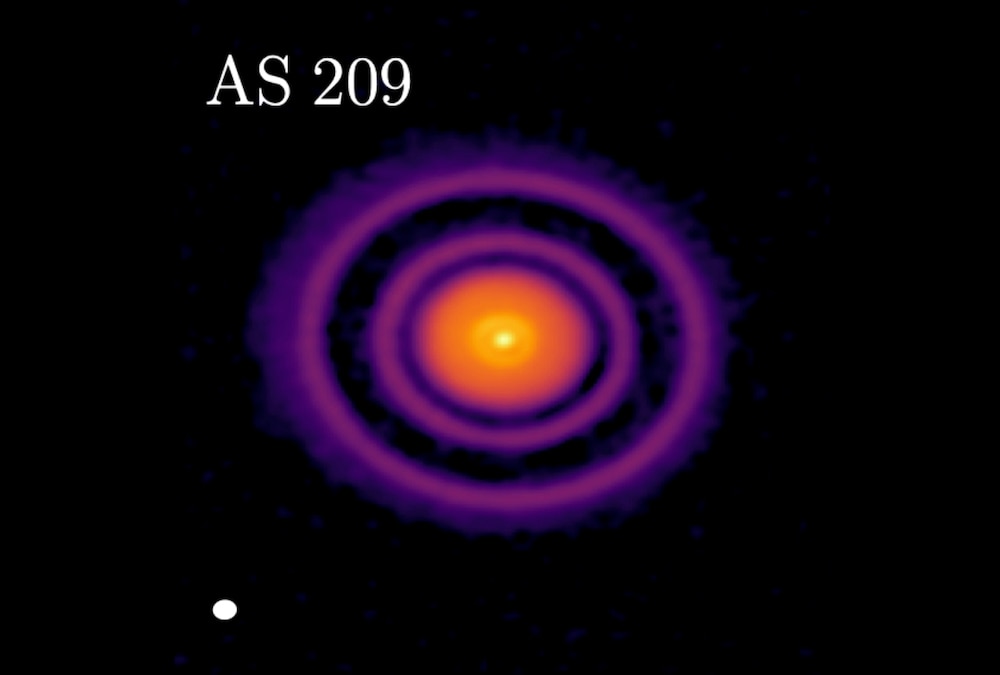
The nearby star AS 209 is pretty astonishing. Located about 400 light-years from Earth, it’s a little bit more massive than the Sun and very young, probably 1 – 2 million years old. It’s part of what’s called the Ophiuchus star-forming region, a sprawling series of dust and gas clouds where stars are actively being born. Observations using the Atacama Large Millimeter/submillimeter Array , or ALMA, show that it sports a circumstellar disk , a flattened disk of gas of dust from which it formed. This is common around young stars, but this one stands out because it’s broken up into a series of annuli, rings: at least seven of them , separated by gaps in the material. One of the outer gaps is probably caused by a gas giant planet forming there with about the same mass as Jupiter ; as it orbits the star it hoovers up material, carving that gap. One of the inner gaps may be due to an orbital resonance , where material orbits the star twice for every one time the planet orbits.…