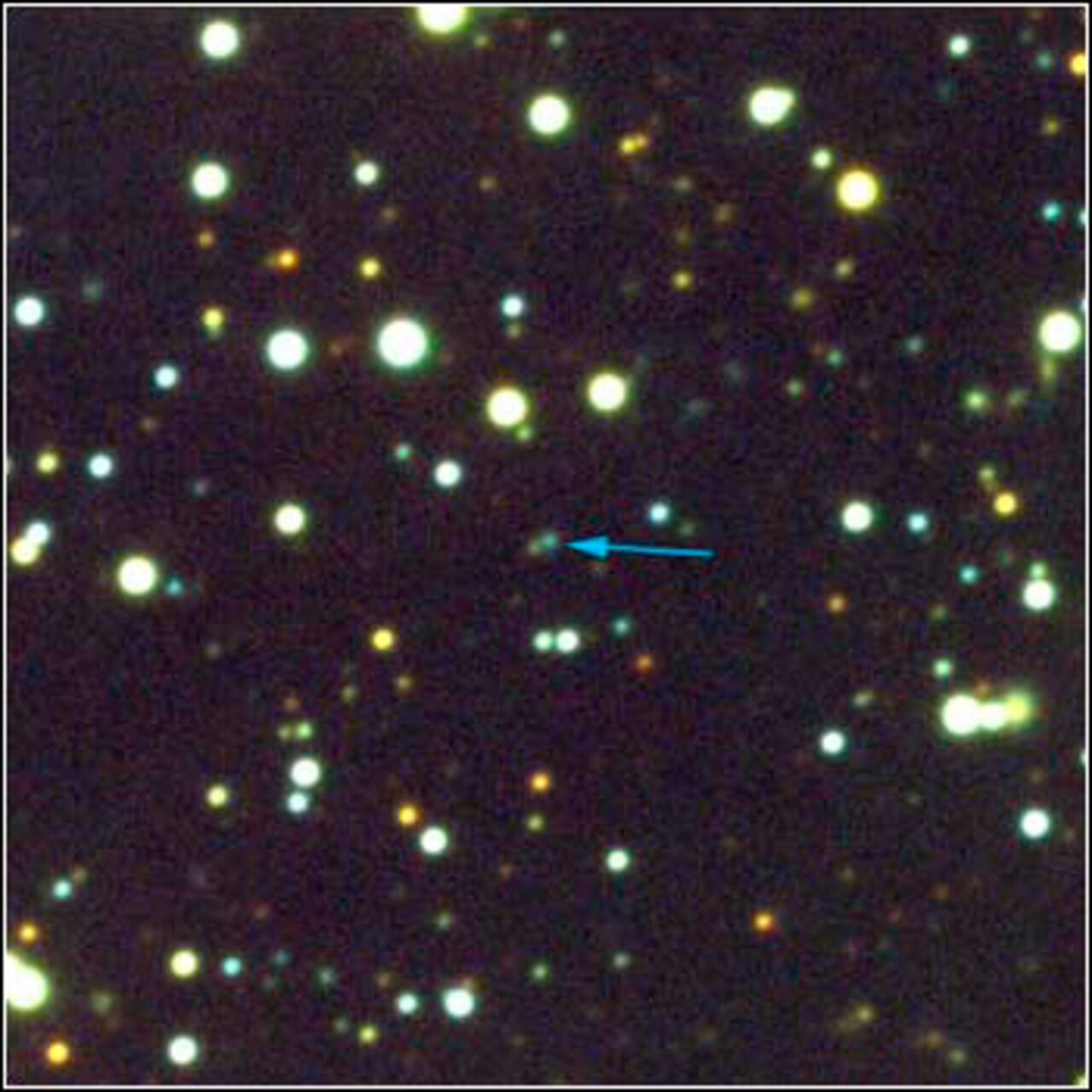
Today in the history of astronomy, the Italian satellite reenters the atmosphere after a successful mission. | Published: April 29, 2026 The blue arrow indicates Gamma Ray Burst 011121. The burst was detected by BeppoSAX in X-ray, providing positioning for the Blanco 4-meter telescope at Cerro Tololo Inter-American Observatory in Chile to capture this optical image a day and a half later, on Nov. 23, 2001. Credit: NOIRLab The Italian Space Agency’s Satellite per Astronomia X (SAX) launched April 30, 1996. Run in collaboration with the Netherlands Agency for Aerospace Programs and nicknamed Beppo after Italian physicist Giuseppe Occhialini , BeppoSAX was commissioned with providing unprecedented spectral coverage in X-ray. This sensitivity allowed the satellite to study weak X-ray sources in new depth and discover transient X-ray events. Among other successes, the mission provided monitoring of Gamma Ray Bursts (GRBs) at a level never before achieved and the first arc-minute position determinations of GRBs.…