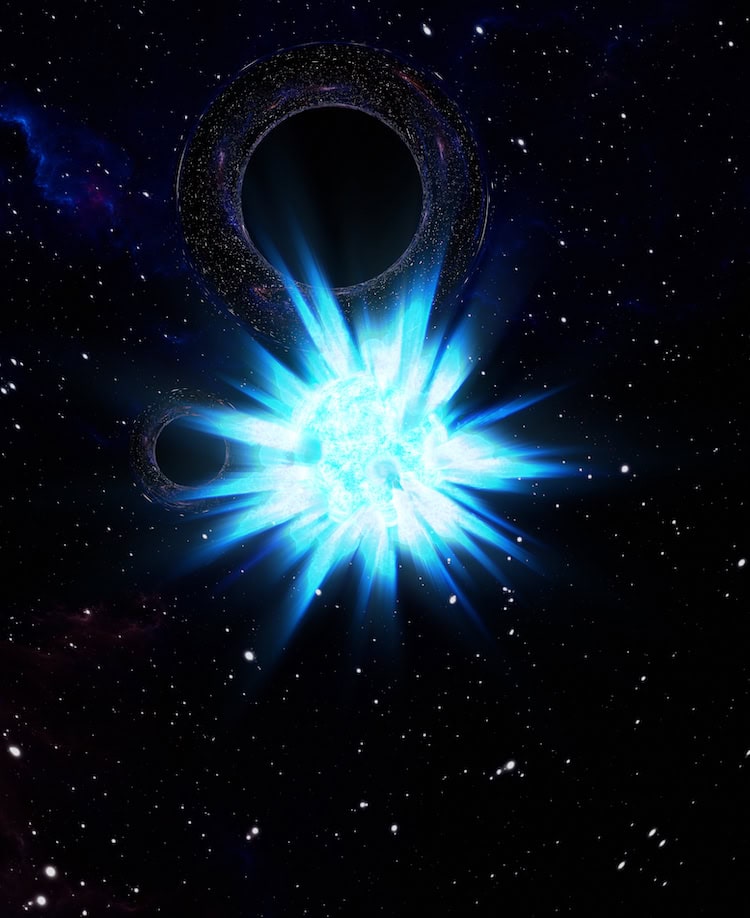
A star's ultimate fate: A stellar explosion with subtle hints of a black hole binary in the background. (Courtesy: Carl Knox, OzGrav – Swinburne University of Technology) Predictions that black holes cannot form within a certain “forbidden zone” of stellar masses have gained support thanks to a new analysis of gravitational waves detected by the LIGO–Virgo–KAGRA network of observatories. The analysis, which was conducted by researchers at Australia’s Monash University, adds weight to the theory that stars between 50 and 130 times more massive than our Sun end their lives in a type of supernova that was predicted in the 1960s but has never been directly observed. Most massive stars collapse at the end of their lives to form black holes. Theories of stellar evolution, however, suggest that stars in a middling-to-higher range of masses will instead explode as so-called “pair-instability” supernovas.…