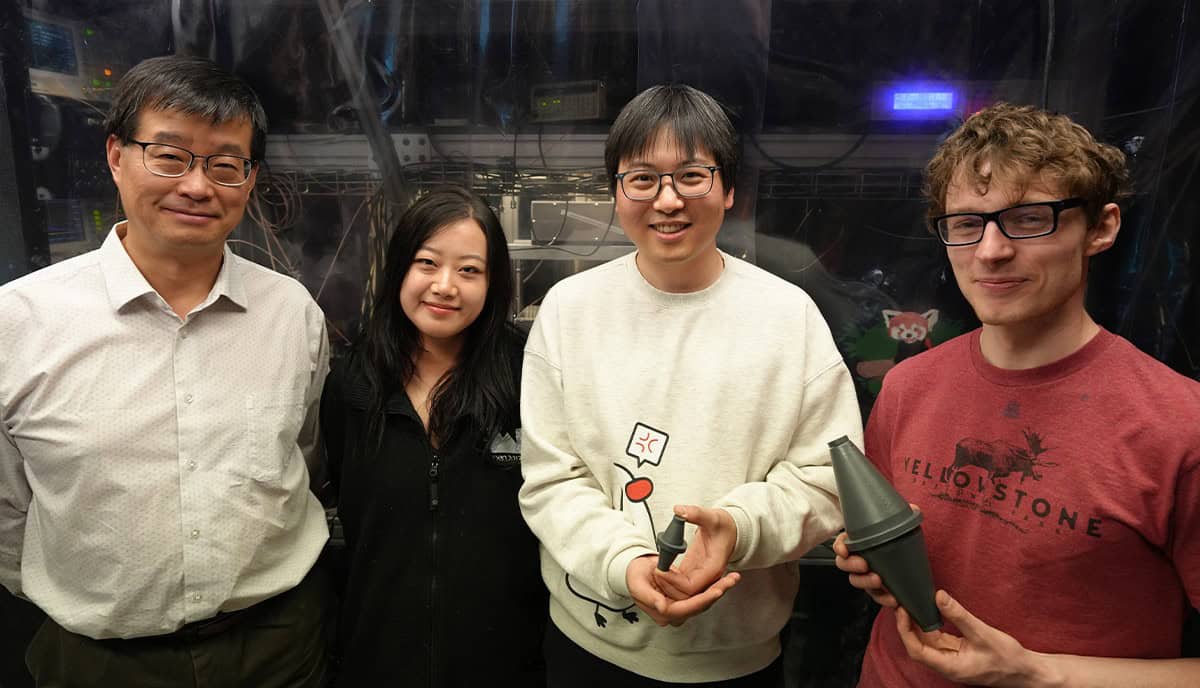
Lunar lasers Jun Ye (far left) poses with members of his team. They are (left to right) Zoey Hu, Dahyeon Lee and Ben Lewis, who are holding replicas of an optical laser cavity. (Courtesy: R Jacobson/NIST)"> Lunar lasers Jun Ye (far left) poses with members of his team. They are (left to right) Zoey Hu, Dahyeon Lee and Ben Lewis, who are holding replicas of an optical laser cavity. (Courtesy: R Jacobson/NIST) There are craters on the Moon where the Sun never shines – and researchers in the US and Germany have shown that these shady locations would be ideal for housing lasers that are more stable than similar devices operated on Earth. Writing in the Proceedings of the National Academy of Science , Jun Ye at NIST and the University of Colorado and colleagues explain the benefits of installing a silicon optical cavity in a permanently shaded crater. Such a cavity is a block of silicon with internally facing mirrors at opposing ends.…