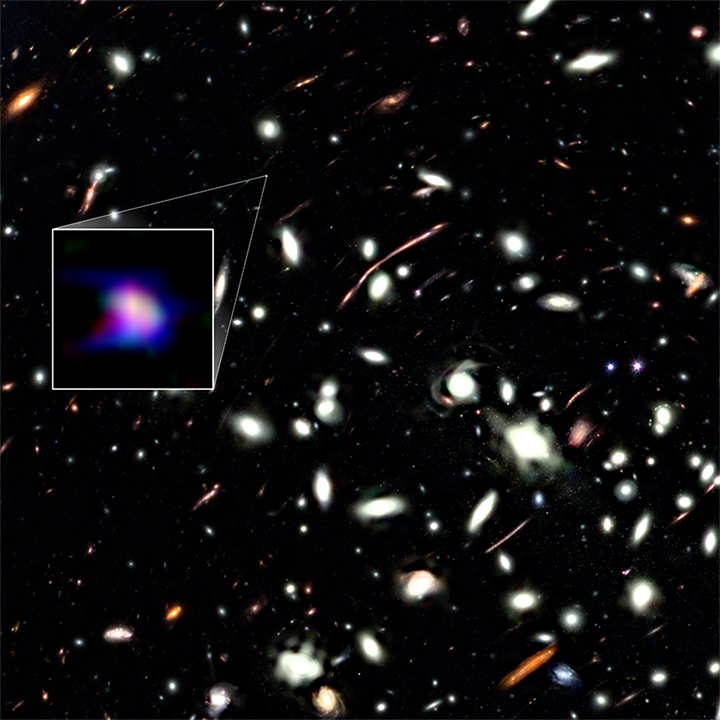
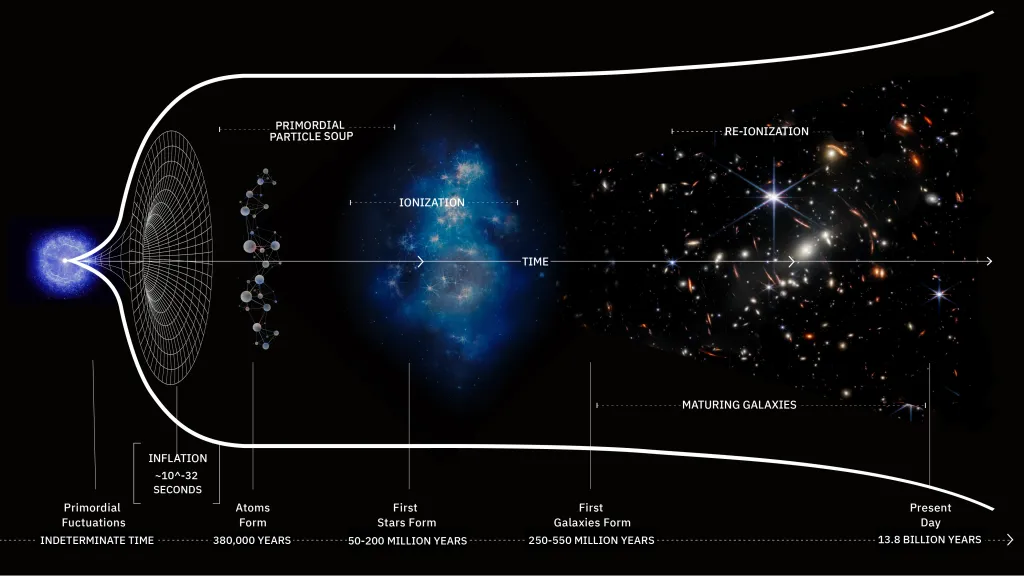
One of the greatest achievements of the James Webb Space Telescope is how it has allowed scientists to push the boundaries of astronomy by observing galaxies that existed during the early Universe, less than 1 billion years after the Big Bang. This period, known as the Epoch of Reionization , coincides with what astronomers have nicknamed the "Cosmic Dark Ages." During this time, 380,000 to 1 billion years after the Big Bang, the Universe was filled with neutral hydrogen, and any sources of light visible today are redshifted beyond the limits of conventional telescopes. Thanks to Webb's advanced infrared instruments and spectrometers, scientists can now peer behind this veil and see how galaxies have evolved since the earliest cosmological epochs. In a recent discovery, an international team of astronomers used Webb and the gravitational lensing technique to capture a rare look at LAP1-B, an ultra-faint galaxy that existed 800 million years after the Big Bang.…