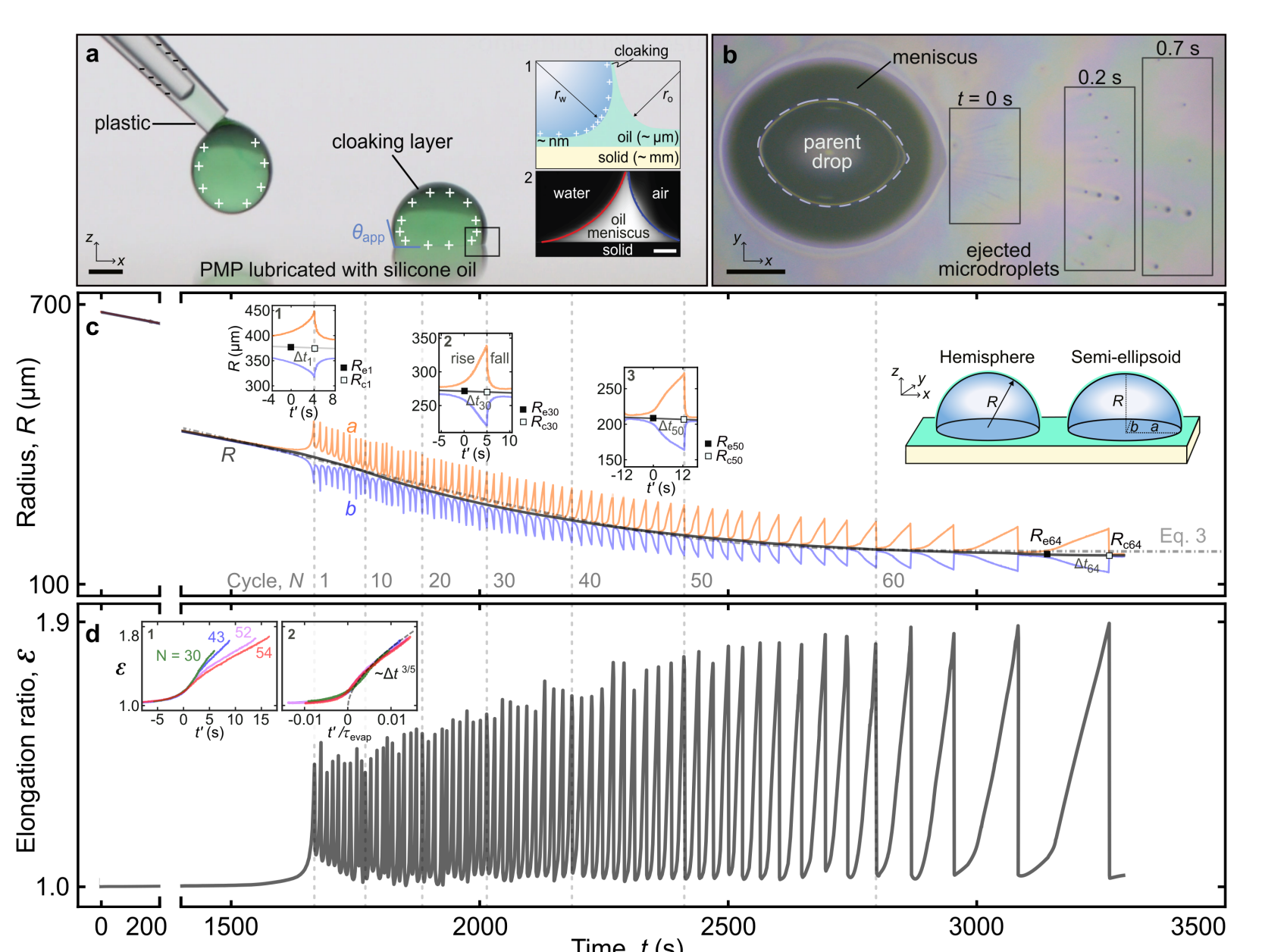
Research from King Abdullah University of Science and Technology , Okinawa Institute of Science and Technology Graduate University , and the Max Planck Institute for Polymer Research shows that ordinary pipetting can leave evaporating water drops carrying enough charge to undergo repeated Coulomb fissions on lubricated surfaces, a result that could inform nanoscale fabrication and other droplet-based manufacturing processes. Published in Proceedings of the National Academy of Sciences , the study reports more than 60 successive fission cycles over about 30 minutes, with each event producing a fine liquid jet that breaks into 40 to 50 microdroplets within microseconds. Charged droplets have been studied for well over a century. In 1882, Lord Rayleigh established the stability limit for electrically charged droplets, a threshold beyond which a droplet becomes unstable and undergoes Coulomb fission. Later experiments confirmed that behavior mainly for levitated droplets.…