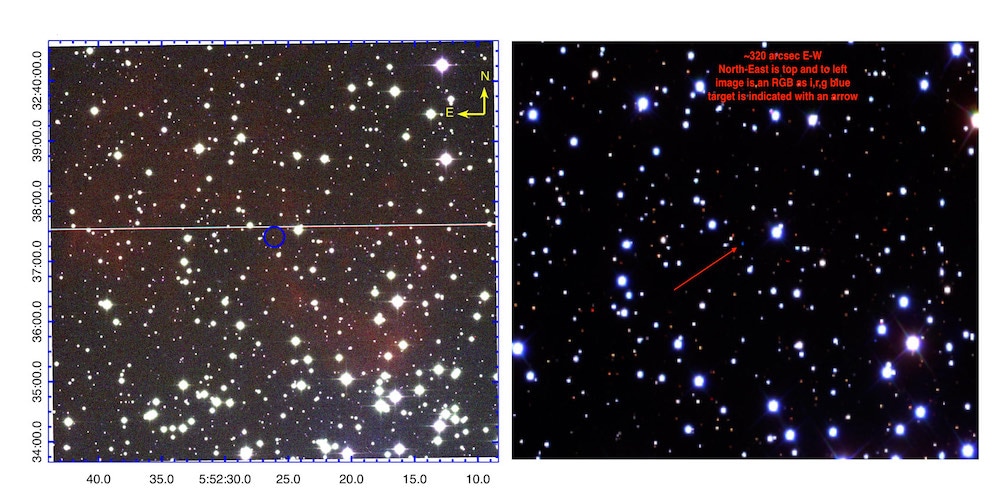
A team of astronomers has found what may be the oldest known planetary nebula ever seen, and certainly one of the biggest . These structures are fleeting on a cosmic timescale, so finding one so old is extremely helpful in nailing down what happens as stars die. Bonus: It was confirmed to be in a bright, nearby stellar cluster, making it far easier to nail down several of its characteristics [ link to paper ]. A planetary nebula is a huge cloud of gas blown off by a star like the Sun as it ages and dies . Stars generate energy by fusing lighter elements into heavier ones in their cores . They can do this for billions of years, but eventually the usable fuel runs out. This sets off a complicated chain of events, but in a nutshell the core contracts and heats up, while the outer layers of the star expand and cool. The star becomes a red giant, and blows a wind of gas away that eventually depletes it of gas. The core of the star, dense and hot and exposed to space, is now called a white dwarf .…