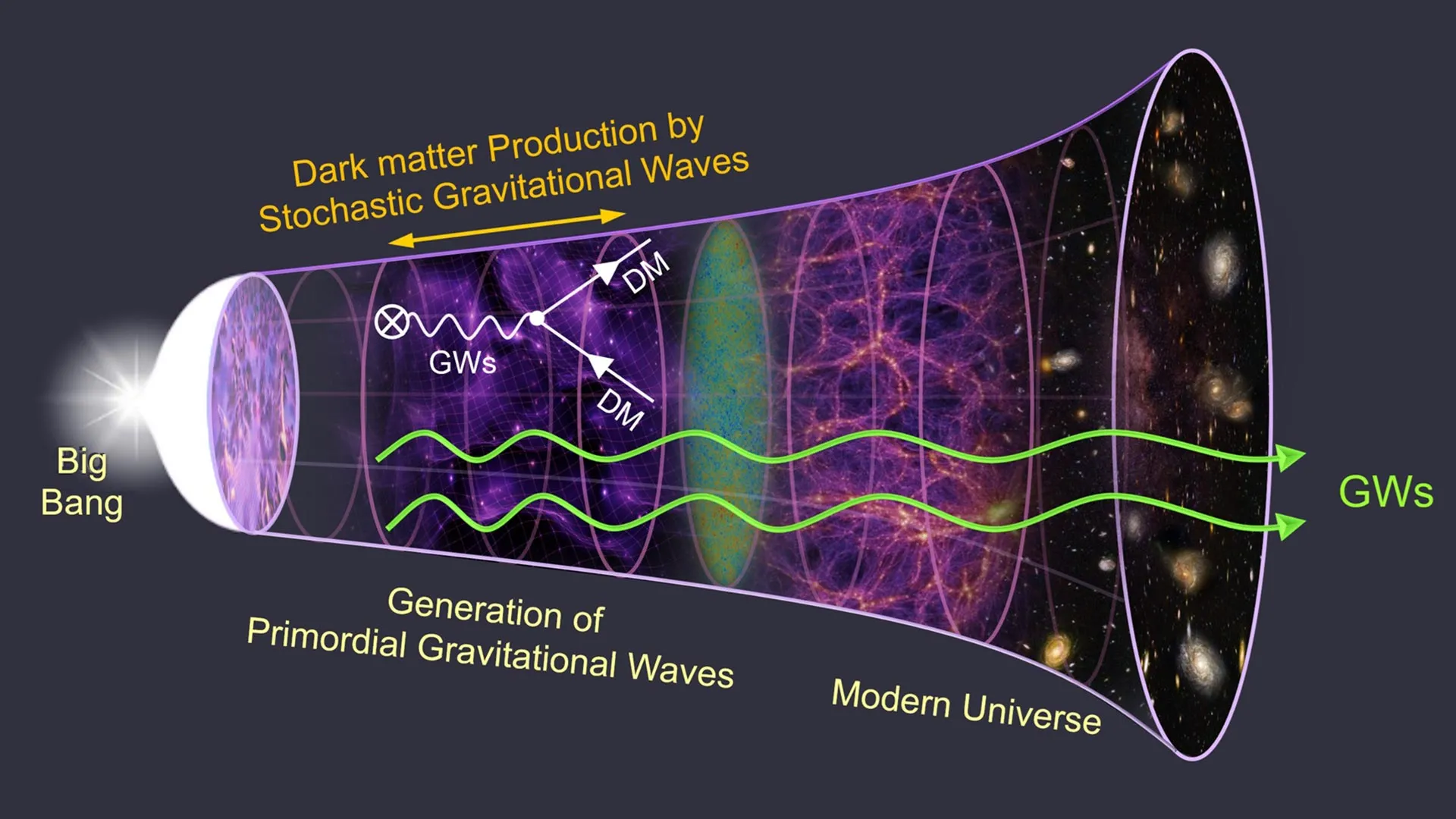
Gravitational waves may have played a key role in creating dark matter during the universe's earliest moments, according to a new study by Professor Joachim Kopp of Johannes Gutenberg University Mainz (JGU) and the PRISMA++ Cluster of Excellence, working with Dr. Azadeh Maleknejad from Swansea University. Published in Physical Review Letters , the research introduces fresh calculations that point to a previously unexplored process in which so-called stochastic gravitational waves could give rise to dark matter. This work addresses one of the biggest unanswered questions in particle physics. Everything we can see, including planets, stars, and life on Earth, is made of visible matter, yet this accounts for only about four percent of the universe. Most of the cosmos remains unseen, made up of dark matter and dark energy. Dark matter alone represents roughly 23 percent of the universe. Observations show that dark matter is spread throughout space, shaping galaxies and the largest cosmic structures.…