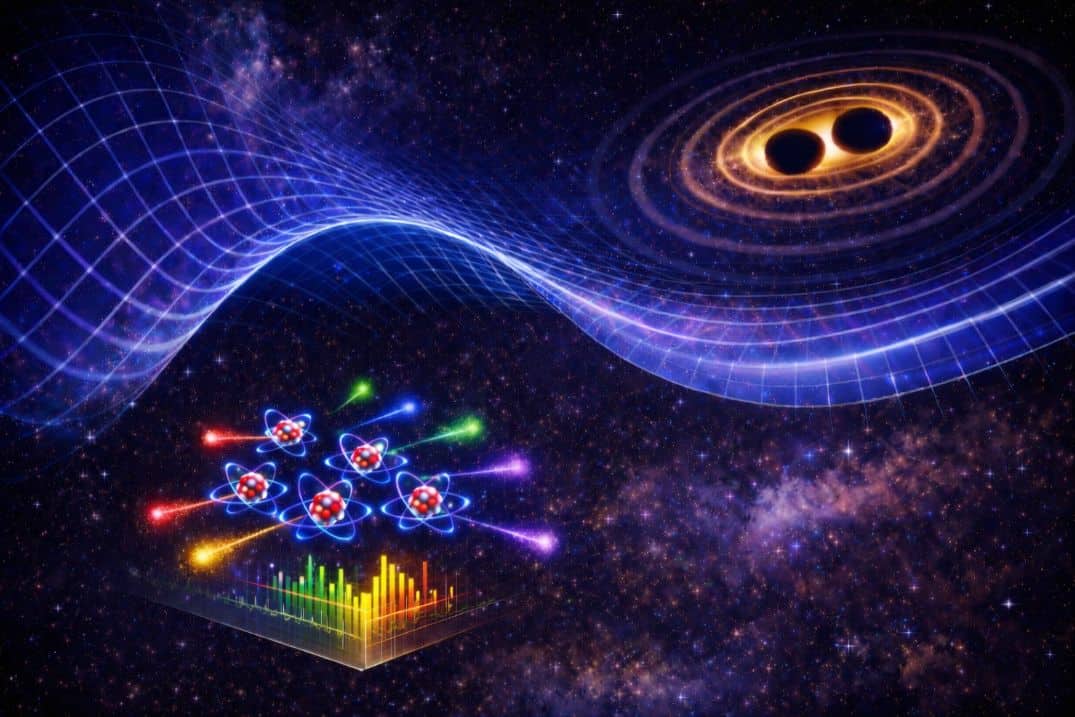
A new type of detector: A gravitational wave ripples through spacetime while atoms emit photons with frequencies and directions that carry information about the wave. (Courtesy: Jerzy Michal Paczos) A single atom is one of the last places one would expect to find a gravitational wave. These ripples in spacetime are caused by movements of massive objects such as black holes, and they are typically detected using instruments that measure tiny changes in the distance between mirrors separated by kilometres. Their home territory is on large scales, not the microscopic scale of an atom. Despite this, physicists have questioned for decades whether gravitational waves might affect how often atoms spontaneously emit photons. Previous theoretical studies suggested that the answer was no: the total spontaneous emission rate of a single atom remains unchanged, so the atom appears unaffected by the wave. This null result is not surprising.…