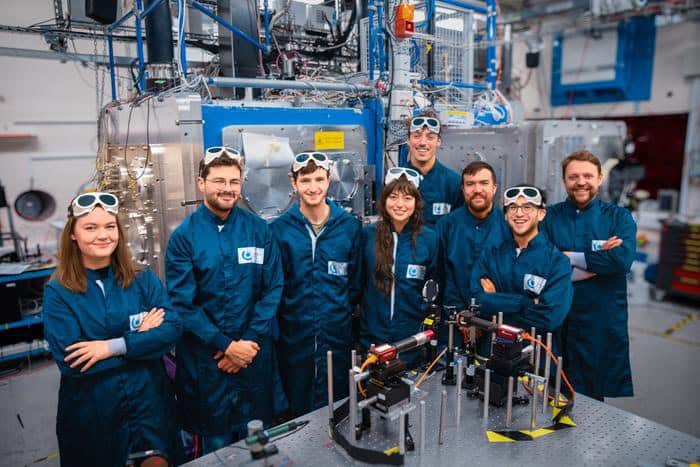
Extreme light team: Members of the experimental team in the Gemini laser target area. Left to right: Holly Huddleston, Jonny Kennedy, Colm Fitzpatrick, Robin Timmis, Elliott Denis, Mark Yeung, Jeremy Rebenstock and Brendan Dromey. (Courtesy: Helen Towrie) Tests of fundamental physics that were previously impossible could become a reality thanks to a new way of producing extremely intense beams of light. Using a state-of-the-art high-power laser, researchers at the University of Oxford, UK demonstrated that they could dramatically increase the efficiency of a nonlinear optical technique called relativistic harmonic generation. According to the team, this increase could herald a paradigm shift, making it possible to achieve hitherto unheard-of electromagnetic field intensities in the laboratory. The theory of quantum electrodynamics (QED) predicts that at very high intensities, light can interact with the vacuum, converting light energy directly into matter.…