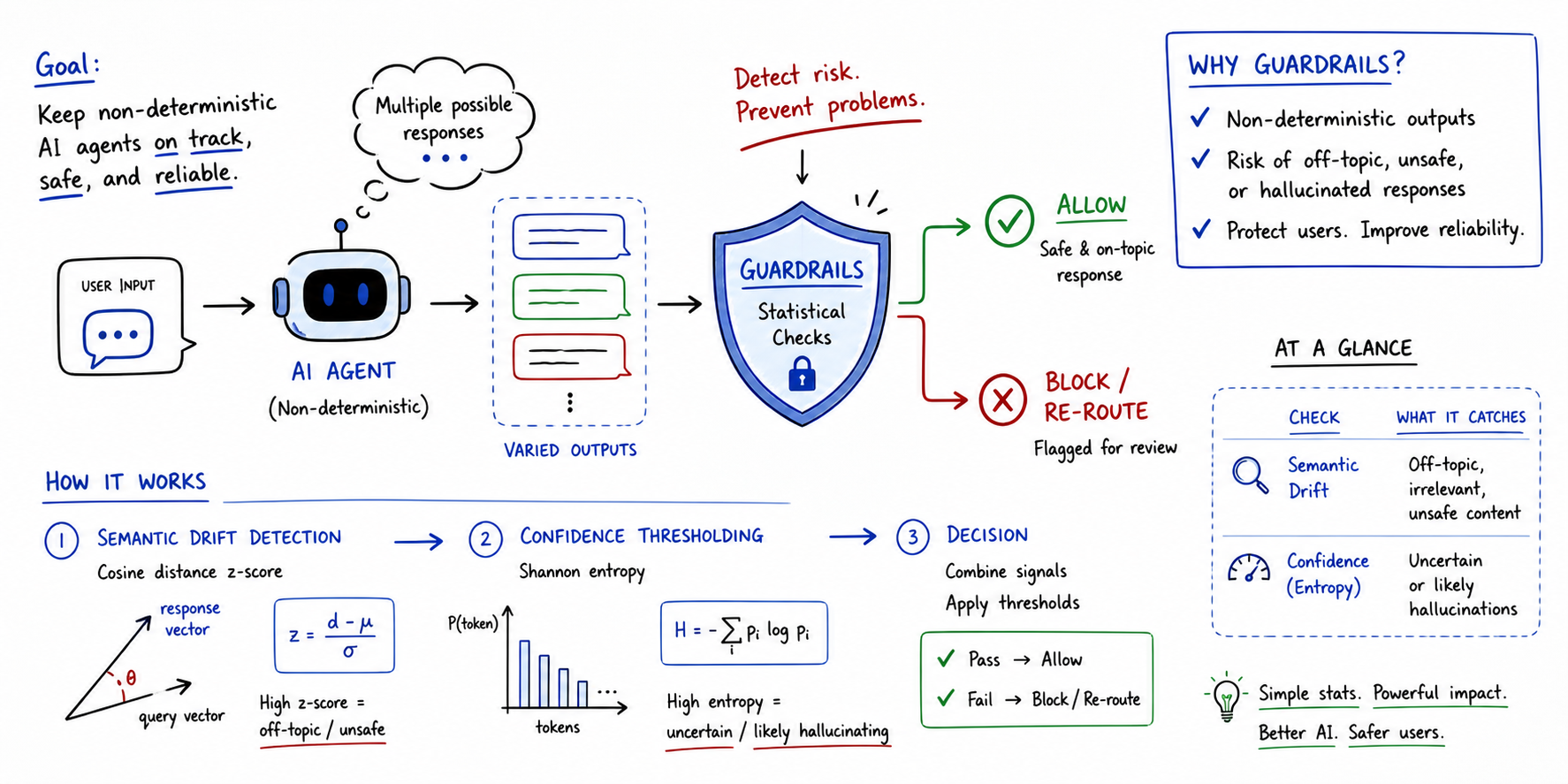
In this article, you will learn what guardrails are for non-deterministic AI agents and how simple statistical methods can be used to implement them effectively. Topics we will cover include: What guardrails are and why they matter when working with non-deterministic agents and large language models. How semantic drift detection, based on cosine distance z-scores, can flag off-topic or unsafe agent responses. How confidence thresholding, based on Shannon entropy, can detect when a model is uncertain or likely hallucinating. Implementing Statistical Guardrails for Non-Deterministic Agents ( click to enlarge ) Introduction Non-deterministic agents are those where the same input can lead to distinct outputs across multiple runs. In other words, their behavior is probabilistic, making standard evaluation methods like unit testing impossible to run.…