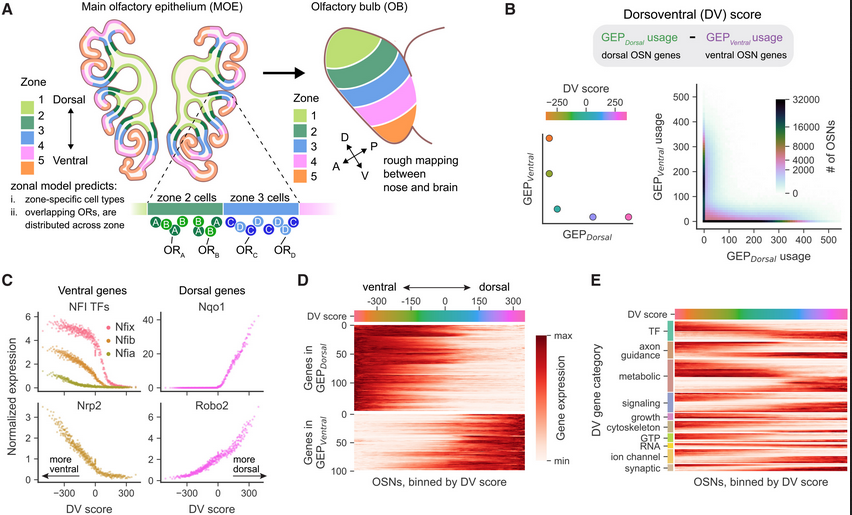
Skip to content The way that the sense of smell works is that olfactory sensory neurons (OSNs) are wired up to olfactory receptors (ORs) in the nasal epithelium, from which they send signals to the brain. Once arrived there, a hierarchy of processing results in us experiencing the sensation of ‘smelling’. Exactly how the olfactory receptor-to-brain mapping works during development, and whether its physical pattern in the nasal epithelium is replicated in the brain, remained major questions until now. In a study published in Cell by [David H. Brann] and others, many of these questions have now been answered, at least for mice. As it turns out, the mapping between OSNs and ORs isn’t performed by a random selection process, but instead creates a receptor map that’s closely matched between the nasal epithelium and the brain. What has complicated answering this question up till now is that the nasal epithelium isn’t a flat surface, but a convoluted labyrinth that maximizes surface area to smell better.…