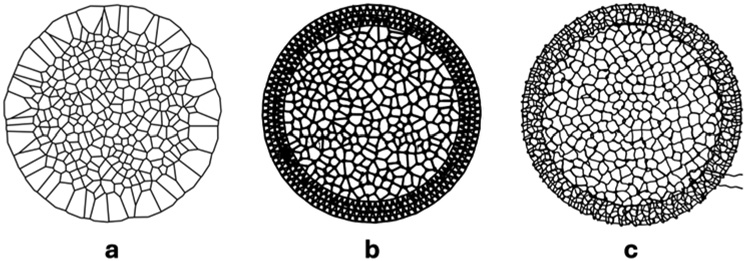
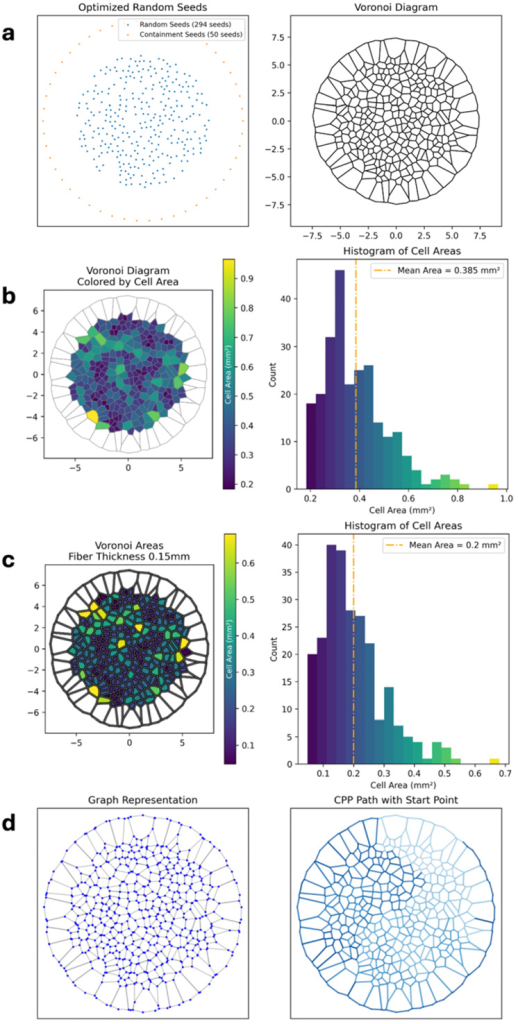
Researchers from Politecnico di Torino and Maastricht University have developed a bioinspired scaffold design approach using a custom Voronoi path generator for extrusion-based 3D printing. Published in Biomaterials Science , the study introduces a Python-based software tool that enables the fabrication of irregular, biomimetic structures through melt electrowriting (MEW) and fused deposition modelling (FDM). The goal is to create more physiologically relevant in vitro lung tissue models. The system generates continuous toolpaths for complex Voronoi geometries that are difficult to produce using standard slicing software. These geometries were used to create scaffolds that replicate alveolar tissue architecture.The printed structures were combined with an electrospun nanofibrous membrane, forming a multi-scale construct designed to mimic the alveolar-capillary barrier. Voronoi-based scaffold design (left) and printed structures produced via FDM and MEW. Image via Farina et al.…