Menu

Post image 1
Post image 2
Post image 3
Post image 4
Post image 5
Post image 6
Post image 7
Post image 8
Post image 9
Post image 10
Post image 11
Post image 12
Post image 13
Post image 14
Post image 15
Post image 16
Post image 17
Post image 18
Post image 19
Post image 20
Post image 21
Post image 22
Post image 23
Post image 24
Post image 25
Post image 26
Post image 27
Post image 28
Post image 29
Post image 30
Post image 31
Post image 32
Post image 33
Post image 34
Post image 35
Post image 36
Post image 37
Post image 38
Post image 39
Post image 40
Post image 41
Post image 42
Post image 43
Post image 44
Post image 45
Post image 46
Post image 47
Post image 48
Post image 49
Post image 50
Post image 51
Post image 52
1 / 52
0

Build DeepSeek-V3: Multi-Head Latent Attention (MLA) Architecture - PyImageSearch

PyImageSearch·Puneet Mangla·about 1 month ago
#D5IVJ2mW
#toc#h2#genesis#download#h1#self
Reading 0:00
15s threshold

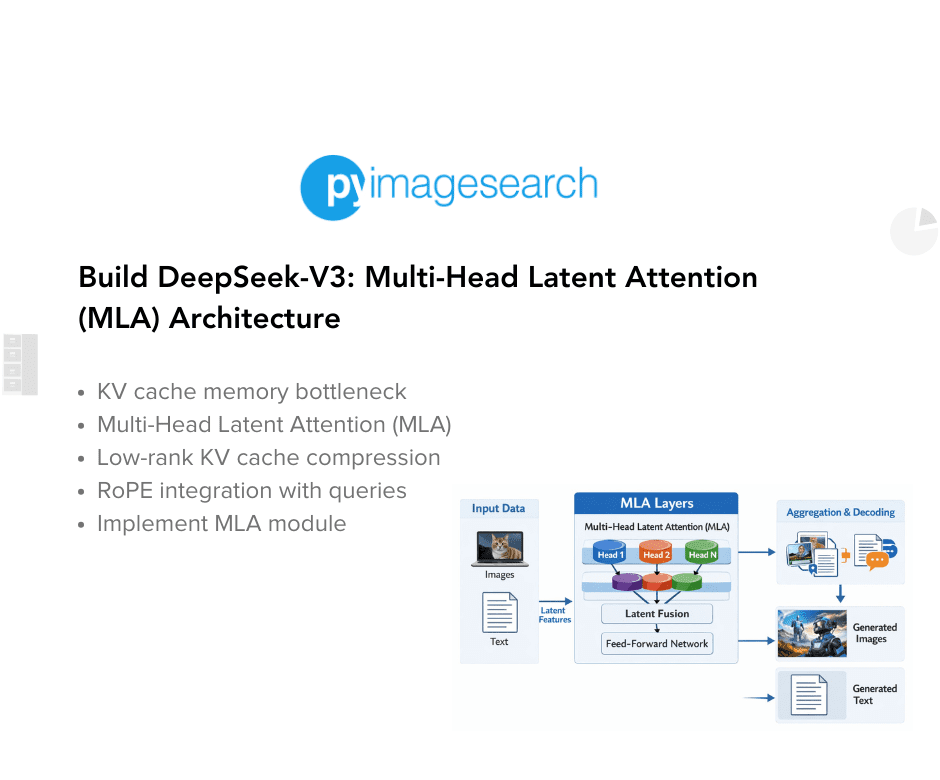
Table of Contents Build DeepSeek-V3: Multi-Head Latent Attention (MLA) Architecture The KV Cache Memory Problem in DeepSeek-V3 Multi-Head Latent Attention (MLA): KV Cache Compression with Low-Rank Projections Query Compression and Rotary Positional Embeddings (RoPE) Integration Attention Computation with Multi-Head Latent Attention (MLA) Implementation: Multi-Head Latent Attention (MLA) Multi-Head Latent Attention and KV Cache Optimization Summary Citation Information In the first part of this series, we laid the foundation by exploring the theoretical underpinnings of DeepSeek-V3 and implementing key configuration elements such as Rotary Position al Embeddings (RoPE) . That tutorial established how DeepSeek-V3 manages long-range dependencies and sets up its architecture for efficient scaling. By grounding theory in working code, we ensured that readers not only understood the concepts but also saw how they translate into practical implementation.…

Continue reading — create a free account

Join HashtagPLUS to read full articles, follow hashtags, vote, and join the conversation.

Read More