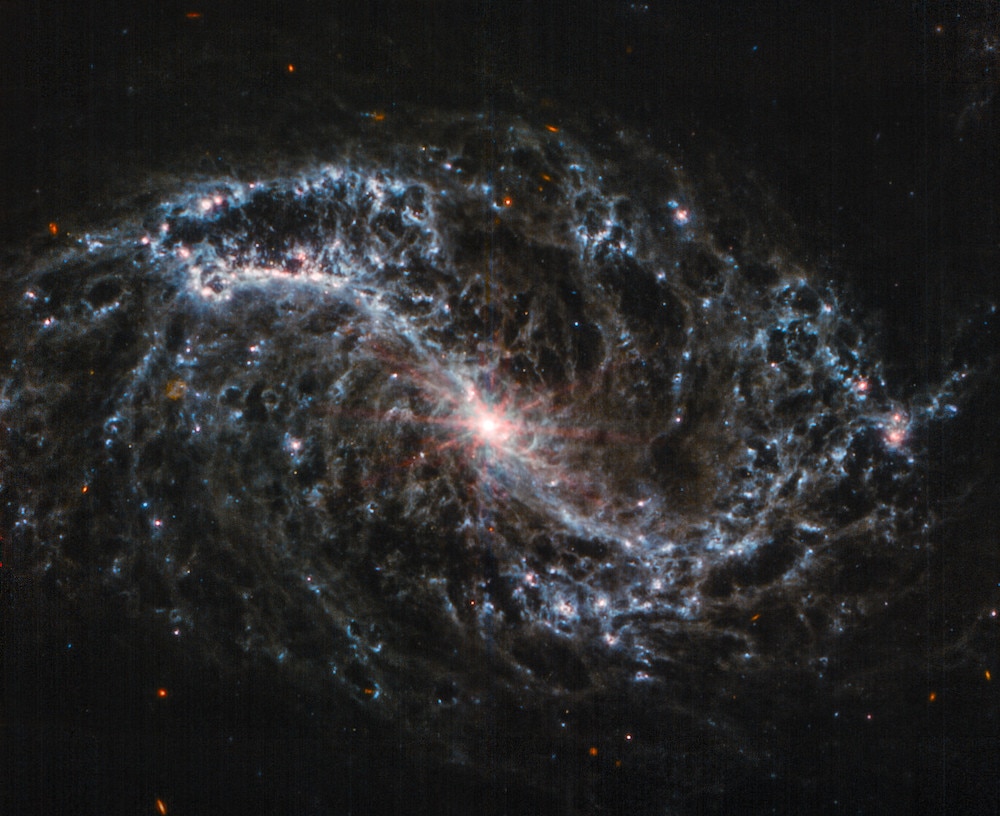
Astronomers — and the public — are still reeling from the first images released taken by JWST . In many ways they’re similar to Hubble images, with amazing clarity and beauty. But in a fundamental way they are very different. Hubble can see ultraviolet light, visible light — the kind we see — and a little bit into the infrared, where light has wavelengths longer than about 0.75 microns, the reddest red we can see. JWST, however, is designed to see in the infrared, with only a little bit of overlap into visible light. Its NIRCAM instrument can detect light from about 0.6 microns out to 5 microns, and MIRI takes over from there, seeing light from 5 out to 30 microns. When you see these wavelengths, the Universe looks very different. Very . One of the coolest (so to speak) examples of this is dust: tiny grains of material made from rocky/metallic molecules or long-chain carbon molecules that are essentially soot.…