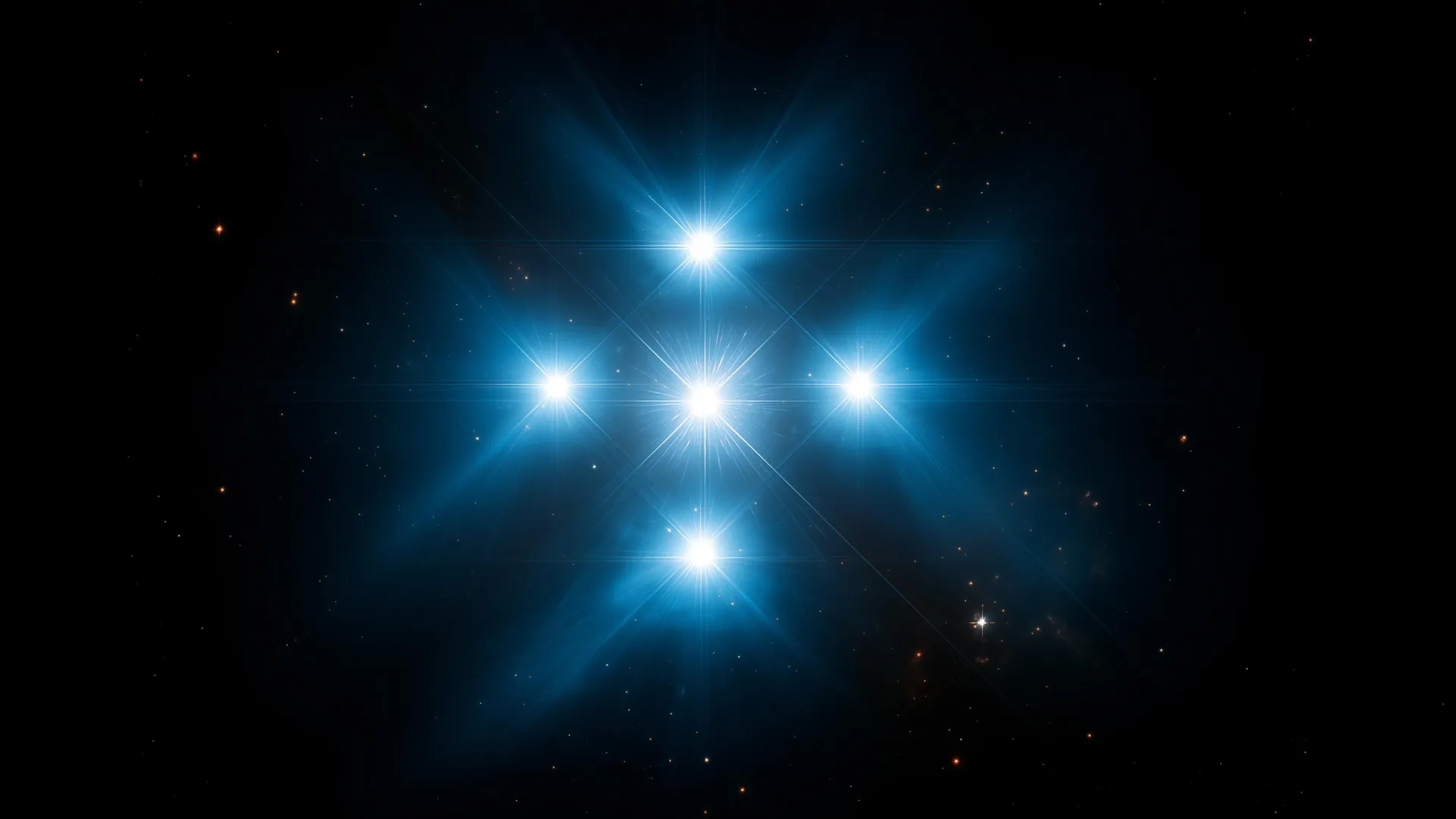
Scientists have known for nearly a century that the universe is expanding, but the exact rate of that expansion is still uncertain. This ongoing debate has even raised questions about the standard model of cosmology. Now, researchers from the Technical University of Munich (TUM), Ludwig Maximilians University (LMU), and the Max Planck Institutes MPA and MPE have identified and analyzed an extremely rare type of supernova that could provide a new and independent way to measure how fast the universe is growing. The object at the center of this discovery is a superluminous supernova located about 10 billion light-years away. It shines much brighter than typical stellar explosions. What makes it especially remarkable is how it appears in the sky. Instead of a single point of light, it shows up five separate times, creating a striking cosmic display caused by gravitational lensing. As the supernova's light travels toward Earth, it passes by two galaxies in the foreground.…