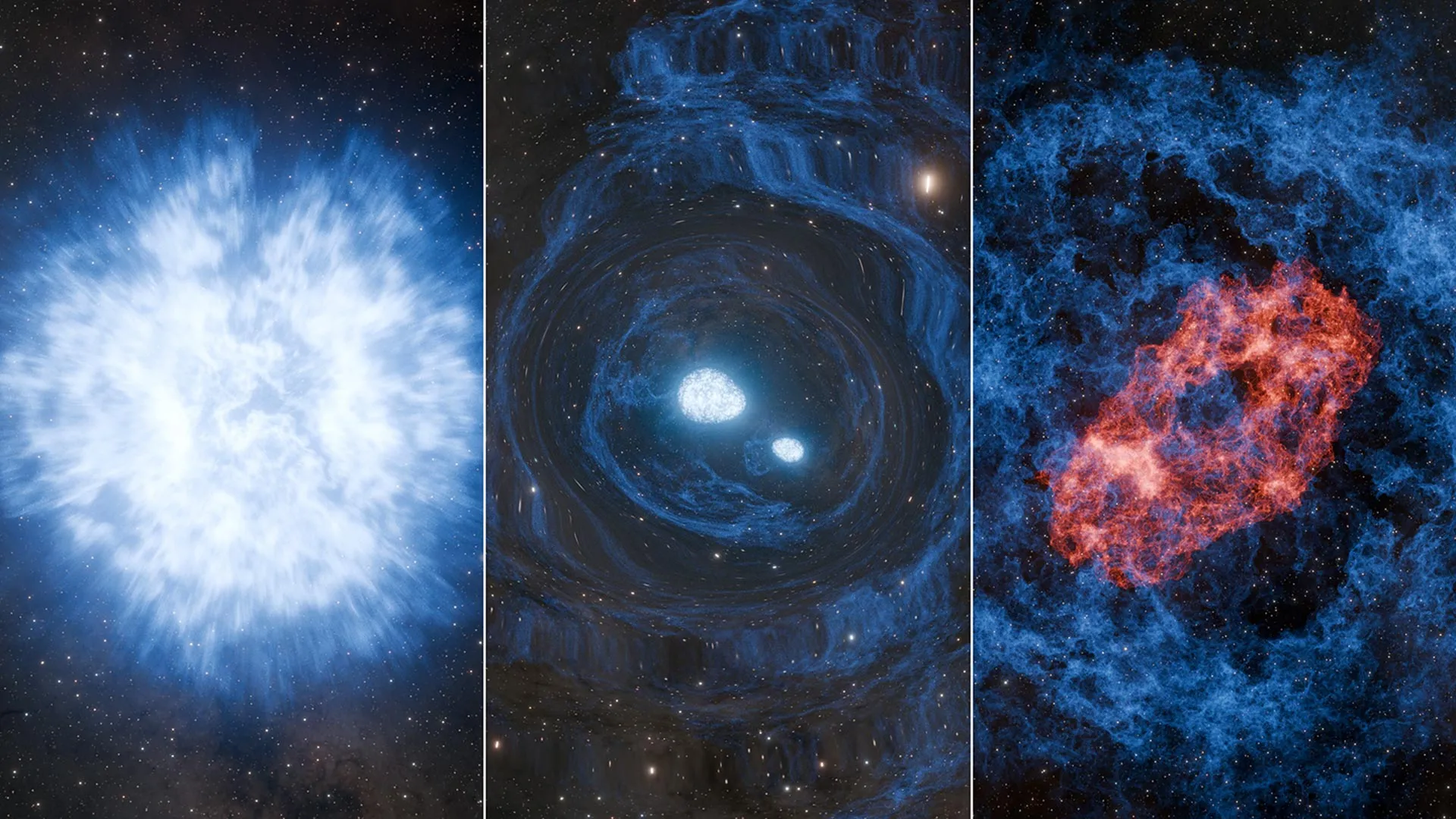
When very massive stars reach the ends of their lives, they explode as supernovae, scattering elements like carbon and iron across space. Another, rarer type of explosion happens when two neutron stars, the dense remnants of dead stars, collide. This event, known as a kilonova, produces even heavier elements such as gold and uranium. These materials are essential ingredients for forming stars, planets, and ultimately everything we see around us. So far, scientists have confirmed only one clear example of a kilonova. That event, called GW170817, occurred in 2017 when two neutron stars merged. The collision sent out both gravitational waves and light, allowing researchers to observe it in multiple ways. The gravitational waves were detected by the National Science Foundation's Laser Interferometer Gravitational-wave Observatory (LIGO) and its European partner Virgo, while telescopes around the world captured the light from the explosion.…